← Home

2026

Handbook of Emotion Development

Chapter · Handbook of Emotion Development

The Intersection of Language and Emotion Across Early Development
Lindquist, K., Whitacre, K., Shablack, H.

This chapter reviews how linguistic environments shape the way children learn to categorize and understand emotions. We synthesize research from infancy through adolescence to show that learning emotion words helps children transition from broad 'good vs. bad' feelings to specific categories like anger, sadness, or fear. My contribution involved integrating recent empirical findings to illustrate how acquiring these emotion concepts actively changes how children interpret both social cues and their own internal states.
Society for Affective Science poster

Poster · Society for Affective Science

Childhood Maltreatment Predicts Perceived But Not Objective Sleep Disruption
Whitacre, K., Feldman, M., Bonar, A., Ma, R., Lindquist, K.

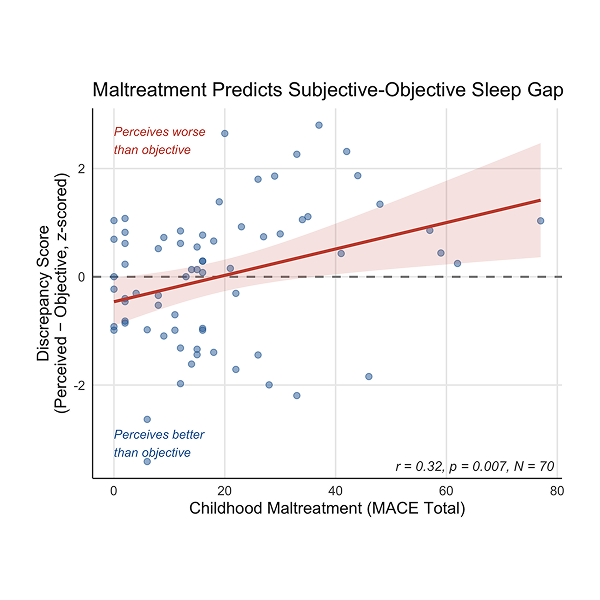
This project originally tested whether beliefs about emotion malleability (PBEM) moderate the link between childhood maltreatment and adult sleep — they did not, across all PSQI components and Fitbit outcomes. The more interesting result emerged from the data itself: maltreatment strongly predicted self-reported sleep disturbances (r = .42, p < .001, N = 131) but showed no relationship with objectively measured sleep via Fitbit actigraphy (r = −.06, ns, N = 97). We formalized this dissociation as a subjective-objective discrepancy score and found that greater maltreatment history predicts a larger perception gap (r = .32, p = .007, N = 70). Exploratory analyses suggest interoceptive emotional awareness (MAIA Emotional Awareness subscale) explains part of this gap (r = .28, p = .020), consistent with a Theory of Constructed Emotion account in which early adversity biases interoceptive prediction toward threat. Age independently moderated the MACE effect on the gap, with the maltreatment-driven perceptual bias attenuating in adults above approximately age 48. ↓ Download Poster
Latent Profile Analysis manuscript

Manuscript in Review · Applied Cognitive Psychology

Latent Profiles of Life Stress and Resilience

Cogdill-Richardson, K., Whitacre, K., Bluck, S.

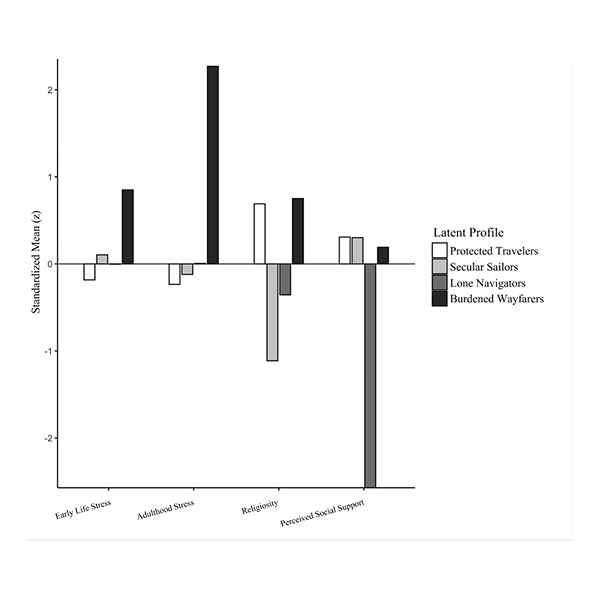
This study applies Latent Profile Analysis (LPA) to identify distinct patterns of life stress exposure and meaning-making within a Dignity Therapy sample. Using person-centered modeling in R and Mplus, we examined how profiles of early life stress, adult stress, religion, and social support relate to psychological outcomes. The study advances beyond cumulative stress indices by identifying heterogeneity in stress exposure and narrative integration.

2025

Invited Talk

Invited Talk · Clinical and Health Psychology Seminar, UF

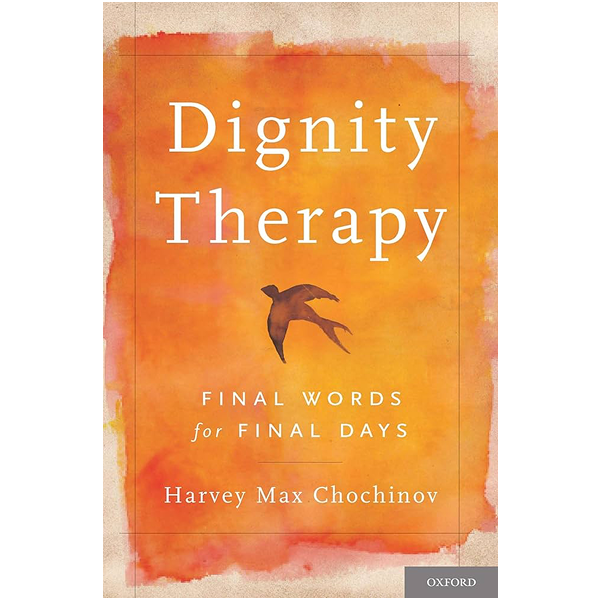
Dignity Therapy and Narrative Mechanisms
Whitacre, K.

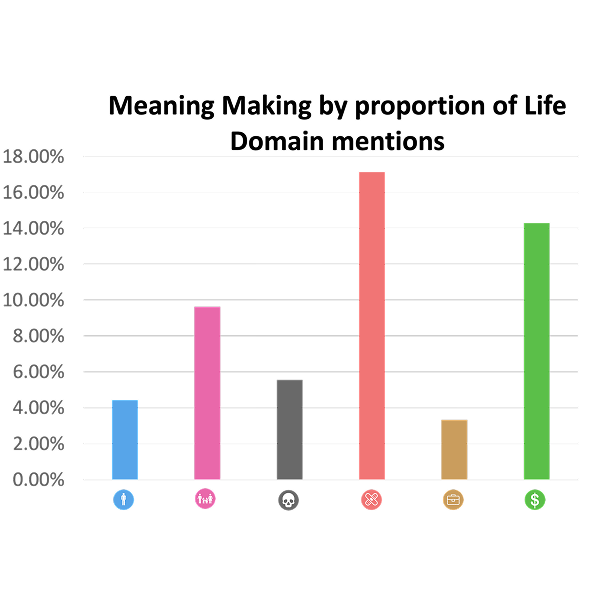
Delivered a 1-hour invited seminar synthesizing theoretical foundations, clinical applications, and ongoing research related to Dignity Therapy. The presentation integrated developmental, narrative, and affective perspectives on how individuals construct meaning around serious illness and life stress. I also discussed emerging quantitative findings and future directions examining narrative integration as a mechanism linking adversity to psychological outcomes. ↓ Download Slides
Poster presentation

Poster · Institute for Learning in Retirement

Dignity Therapy for Older Adults: Revisiting Early Life Stressors

Whitacre, K., Cogdill-Richardson, K., Bluck, S.

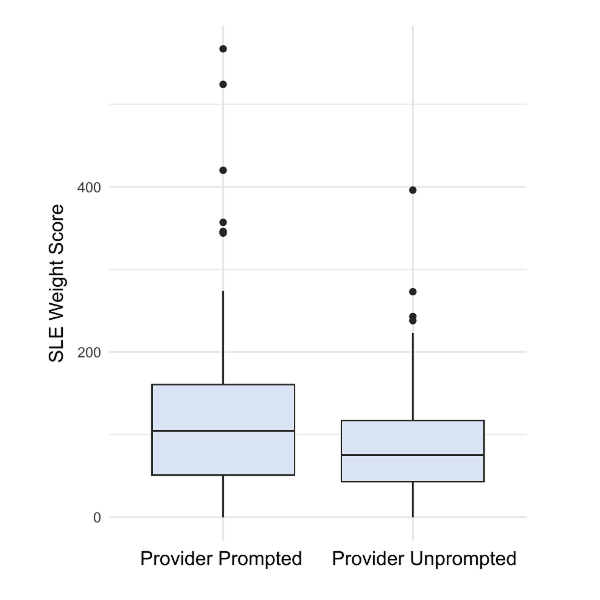
This follow up project examined how individuals with varying levels of early life adversity differed in the types of stressors they discussed during Dignity Therapy and how they constructed meaning around those events. Rather than focusing solely on exposure, we analyzed patterns in the content of narratives, including whether stressors were self initiated or emerged in response to provider prompts. Using structured content coding and quantitative comparisons, we investigated how cumulative early adversity related to narrative emphasis, thematic focus, and meaning making processes. ↓ Download Poster

2024

UF Cancer Institute poster

Poster · UF Cancer Institute Research Showcase

Dignity Therapy for Older Cancer Patients: The Role of Early Life Stressors
Whitacre, K., Cogdill-Richardson, K., Bluck, S.

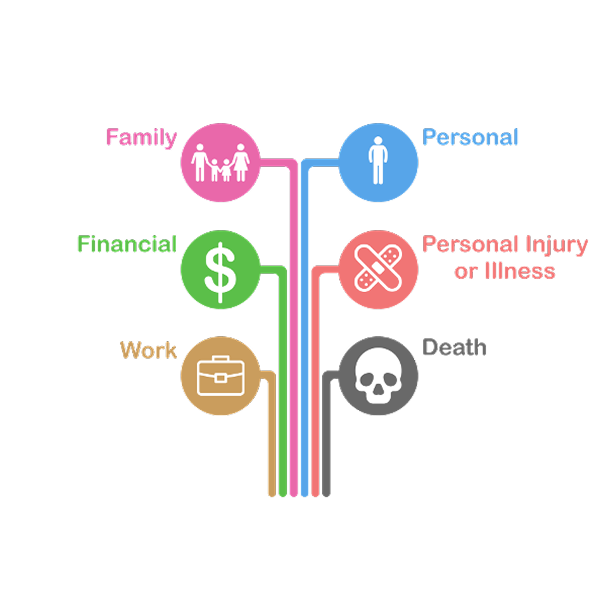
Building on prior coding work, this project examined how early life adversity is incorporated into narrative meaning in terminally ill cancer patients undergoing Dignity Therapy. Using a dataset of over 200 participants, I independently double coded transcripts and conducted quantitative analyses in R. We investigated whether the presence and severity of childhood stressors predicted differences in how individuals construct and interpret their life stories. Findings highlighted the important role of provider prompting in eliciting meaning making. ↓ Download Poster
Life Story Lab

Project · Life Story Lab

Stressful Life Events in Dignity Therapy

I qualitatively analyzed over 140 Dignity Therapy transcripts to identify and classify stressful life events described by older adults with cancer. We developed a modified Social Readjustment Rating Scale to support systematic biographical coding, and I achieved strong interrater reliability (κ = .81). This project examined how individuals reference and contextualize life stressors within structured narrative interventions. The work laid the foundation for examining how early adversity is integrated into later life meaning making.

2023

Cognition and Decision Modeling Lab

Project · Cognition and Decision Modeling Lab

Eye Tracking Decision Making

This project examined decision making and reward processes using behavioral paradigms and eye tracking methodology. I assisted in participant coordination, experimental administration, and quantitative analysis in R. The study investigated how multiple weighted choices alter cognitive processing and choice behavior. This experience provided formal training in experimental design, behavioral data analysis, and computational modeling.